
Large Survey Process Step 2
Step 2a. What do you hope to learn from your survey?
What important things are you trying to learn from your survey? Are you evaluating whether your program, policy, or practice was effective or needed? Taking inventory of people’s experiences, skills, or program use? Gathering some baseline data?
Why do we ask this question on the Large Survey Request Form?
We review survey content to help us coordinate projects with similar content. We can also put you in touch with people who may already have the data you need.

Tips for Best Practice
You can think about your survey project as research: you’re trying to learn about a topic. Research questions can help you stay focused on your learning goals.
Much like selling under the guise of research isn’t helpful, the best research questions are unbiased.
- Biased: I want to prove that my program will raise the first-year retention rate.
- Unbiased: I want to evaluate whether my program will raise the first-year retention rate.
Your research question tells you what is important about your survey, including the direction your project takes: the data you gather, the analyses you conduct, the reporting you do, and more.
The reverse is not true. You cannot conduct a survey and expect it to tell you what is important. There are too many variables that can be combined in too many ways. Take a peek at spurious correlations to see why data without research questions aren’t informative.
Step 2b. How do you hope to utilize the survey results?
In what ways will you use what you learn from the survey to support current initiatives or drive new ones?
Why do we ask this question on the Large Survey Request Form?
We consider the end goals of proposed surveys to help us coordinate projects with similar content. We maintain a history of completed surveys that can be referenced to point you to surveys already conducted that had similar end goals to prevent duplicate efforts.
Tips for Best Practice
• Be transparent with participants about why they are being surveyed and how their input will be used.
• Focus on using the data in an actionable way that can point to next steps.
• Determine the appropriate audience for seeing and using the results.
• Weave your findings into a story to make it clear what they mean and guide how they may be used.
Step 2c. Does the evidence you need already exist?
As we mentioned on the Welcome page (opens in a new tab), Wake conducts a lot of surveys. All these surveys are a lot of work, both for you and for your participants. Not only do you have to organize and execute the survey, but you also have to analyze and report on the data before you can implement your findings. Our participants put a lot of time and thought into answering survey items, many of which are similar across surveys.
Previous large surveys
One way we can get the evidence we need and reduce the number of surveys we conduct is to use existing survey data. We can also collaborate with other people who are conducting similar surveys.
You can use the Large Survey Dashboard (opens in a new tab) to see what large surveys were previously administered at Wake and identify other people who are conducting similar surveys. You can filter the Dashboard by population, survey date, and survey topics (see Step 3 for more details); see the survey instrument itself; and retrieve contact information for the researcher who administered the survey to learn more.
Why do we ask this question on the Large Survey Request Form?
The result of Wake’s frequent surveying is that our response rates and data quality are declining. By making better use of our existing data and conducting more collaborative surveys, we may be able to administer fewer surveys and improve the quality of our survey data.

Tips for Best Practice
Survey data are not the only source of evidence. Maybe you can find the evidence or data you need elsewhere, or maybe you don’t need survey data at all.
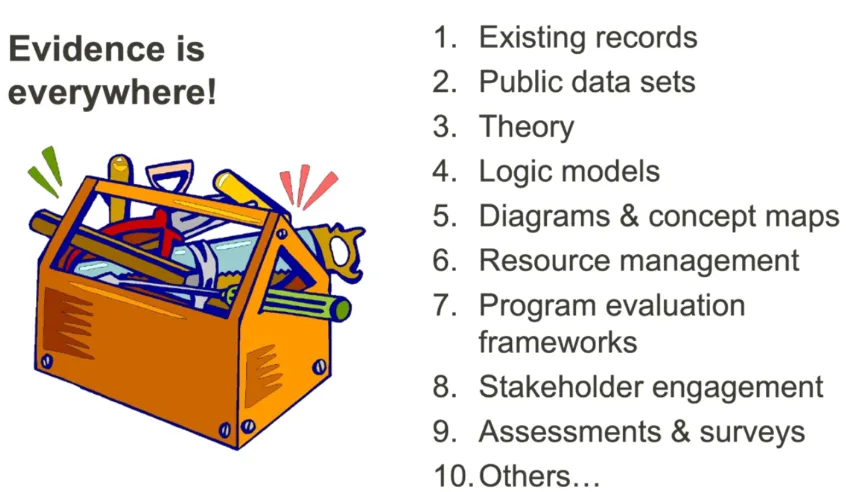
Below are some examples of data that Institutional Research can help you locate. Other sources might be found in your department’s records, other administrative offices, or in departments that you might collaborate with.
WFU Fact Book
The Fact Book (opens in a new tab) is an online, interactive publication reporting comprehensive information about Wake Forest. In addition to the general information about the university, its history and its purpose, the Fact Book also provides frequently requested longitudinal data regarding our students, faculty, staff, finances, and facilities.
IPEDS
The Integrated Postsecondary Education Data System (IPEDS; opens in a new tab) is a collection of interrelated data surveys conducted annually by the U.S. Department of Education. IPEDS gathers information from 6,400 colleges, universities, and technical and vocational institutions that participate in the federal student aid programs. The data include information about institutions’ students, faculty, staff, revenues, and expenditures. Nearly all U.S. universities participate in IPEDS. The data are longitudinal, and the definitions are consistent across schools. This is a very valuable resource if you are interested in comparing Wake to peer institutions (opens in a new tab).
Common Data Set
Similar to IPEDS, Wake also annually produces the Common Data Set (CDS; opens in a new tab), a collaborative effort among the higher education community to provide summary data to the public about the institutions’ students, faculty, finances, and financial aid. Many of the data in the Common Data Set are also found on the IPEDS website – one notable exception is that the CDS reports the number of undergraduate class sections by class size (e.g., 2-9 students, 10-19 students, etc.). As with IPEDS, since participating schools are using the same definitions, comparisons across institutions may be made. Unlike IPEDS, there is no central CDS repository. You have to search for each institution’s CDS separately.

Your research questions determine your direction, not the survey.
Questions? Contact us at