
Large Survey Process Step 8
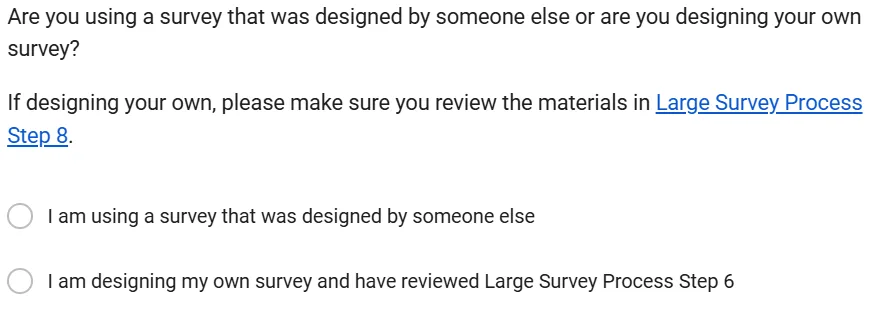
Step 8a. Are you using a survey that was designed by someone else or are you using your own survey?
A key decision in your survey project is, of course, which survey you decide to use! You can decide to use a pre-existing one or build your own. Either way, you will need to provide us with a copy and an estimate of how long the survey will take.
Survey design options
When you’re selecting your survey (or—more precisely—the instrument you will use in your survey), you have two options:
- Surveys designed by someone else (our recommendation)
- Surveys you design yourself
Why do we ask this question on the Large Survey Request Form?
We ask you to identify whether you are using an existing survey or you have created your own survey so that we can distinguish between them in our Past Large Survey Directory. This distinction helps us identify the best possible sources of existing data for any new project.
Tips for best practice – Option 1: Surveys designed by someone else (recommended)
Many surveys have been designed just for higher education. Some are free, some are not.
Whenever possible, we recommend using existing surveys that were designed by someone else. When you can use an existing survey, you take advantage of the research that developed that instrument. Existing surveys are often developed through multiple studies with teams of researchers. These surveys have evidence bases that support their validity, reliability, and usefulness.
Examples of surveys administered previously at Wake include the National Survey of Student Engagement and the National College Health Assessment.
Check out the Large Survey Dashboard to see if any of those surveys might meet your needs. The dashboard allows you to filter by population and survey date, see what topics we’ve surveyed about, see the survey instrument itself, and contact the researcher who administered the survey to learn more (and maybe ask for a copy of their data!).

Existing surveys are built on evidence bases.
Tips for best practice – Option 2: Surveys you design yourself
Sometimes you need to design your own survey instrument. To help you through the process, we have assembled some articles below.
Designing your own survey can be a big undertaking. Entire books and courses are dedicated to this topic. People get expensive, advanced degrees in psychometrics and survey methodology. We strongly encourage you to design your own survey carefully, and please reach out to us for help!
Here are links to resources that can help you with your survey design:
- Formats of survey questions
- The ever-popular Likert-type scales deserve extra attention. These items have response scales that look like ratings, for instance: strongly disagree, disagree, agree, strongly agree. Likert-type scales can be challenging to analyze. When they have 4 or fewer options, Likert-type scales should not be treated like numbers (i.e., continuous scales); you should avoid using averages (“means”) or other common quantitative statistics.
- Wording of survey questions
- The tone and language in your items matter. Avoid bias in your items, for instance by asking questions like, “You agree, don’t you, that…”
- Question order
- The order of your survey questions matters! For instance, items that come early in a survey can alter people’s responses to later items. Putting demographics at the end of the survey (instead of the beginning) can improve response rate.
- Making questions clear to the respondent (not you)
- Use language tips to make sure your respondents give you accurate answers. For instance, make your items concise, only include one topic in each survey item, and avoid technical jargon.
- Survey length
- When surveys are longer than seven or eight minutes, participants put less time into answering items and are more likely to quit the survey before they finish.
- Piloting your survey before you administer it
- Pilot (test) your survey with a small group of participants to make sure that your items are clear and that everything about the survey works the way you want it.
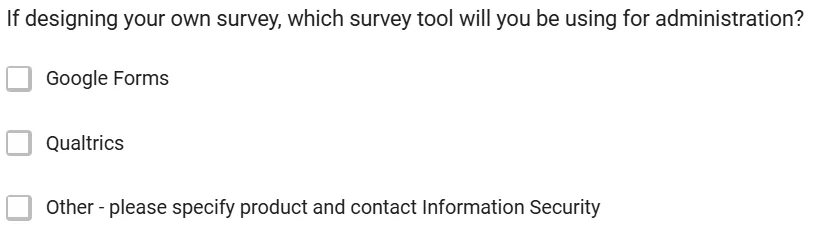
Step 8b. If designing your own survey, which survey tool will you be using for administration?
Will you be using a tool that Wake has already licensed (e.g., Google Forms, Qualtrics, Poll Everywhere, etc.)? If using a new tool, what is your justification for doing so? Knowing this information helps inform decisions on which tools the university should purchase a license for based on the ones that are most commonly used and assess the security risks associated with each one.
Note that if you select Other – please specify product and contact Information Security, the approval of your survey will be pending their decision.
Why do we ask this question on the Large Survey Request Form?
Data collected from this question will be shared with internal partners to help them assess the security risks of platforms, and determine if new platform licenses should be purchased. It also helps Information Services monitor usage across platforms for which licenses have already been purchased.
Tips for best practice
- Familiarize yourself with the survey software options that Wake already offers.
- Decide which platform offers the best balance between hosting your survey and learning how to use it.
- Reach out to Institutional Research () or Information Services (help.wfu.edu) for any suggestions or help needed as you get started.
Questions? Contact us at